How to Audit a Detergent Sheets Factory: Verifying Real Production vs Trading-Desk Operations
A detergent sheets factory audit is a physical-evidence exercise, not a paperwork exercise. Before price, MOQ or scent profile is negotiated, the audit has to establish whether the supplier actually owns production capacity — plant area, workshop classification, headcount and line output — or whether it is a trading desk forwarding orders to someone else's line. Zhejiang Kelee Technology Co., Ltd., a solid-form cleaning manufacturer founded in 1999 and based in Yiwu, Zhejiang, China, operates a 16,000 m² production site, a 100,000-class dust-free workshop, a workforce of 150 and an annual output of 30 million units. Those four figures are exactly the kind of numbers an audit is designed to verify.
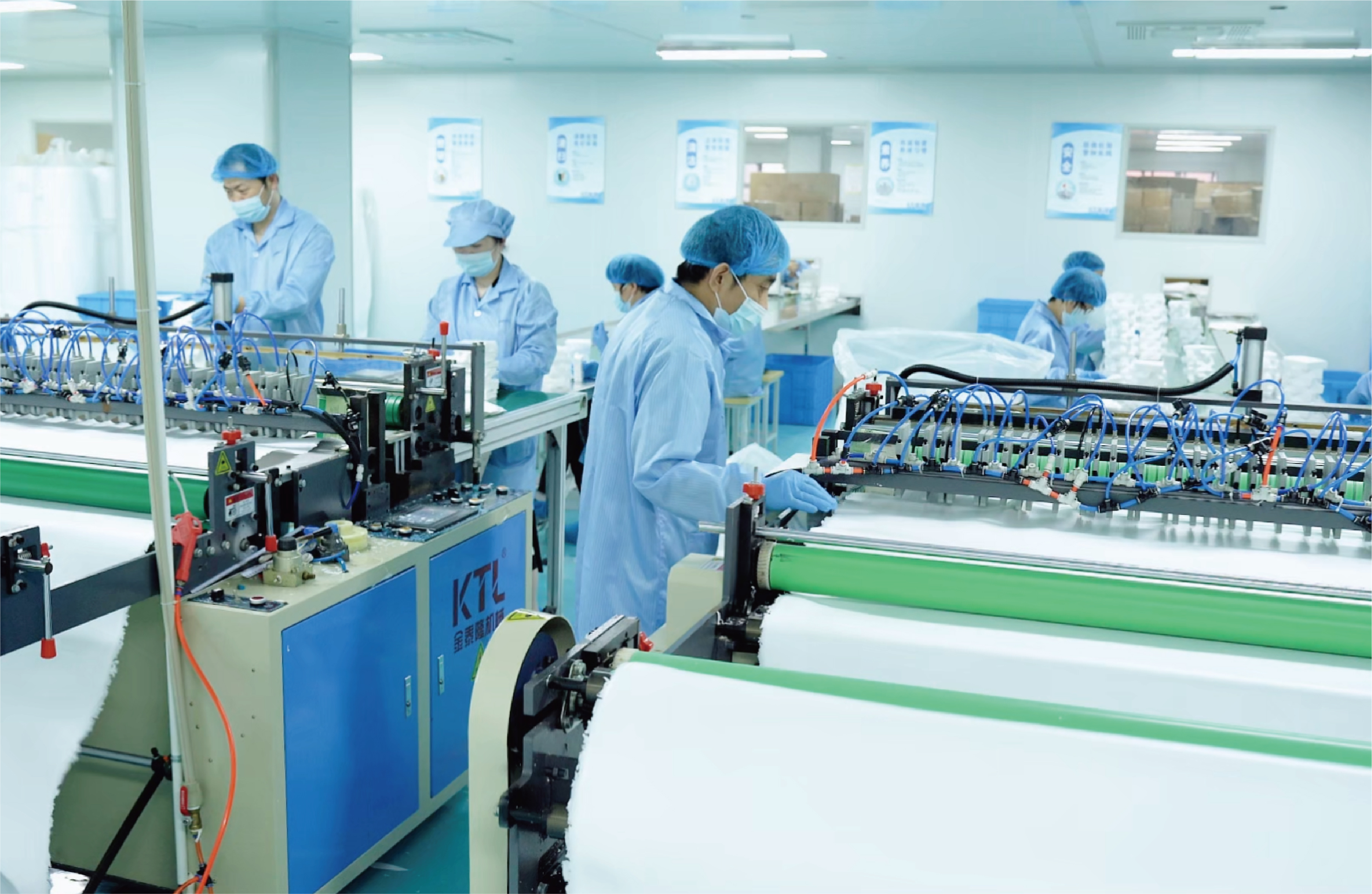
Production workshop, Zhejiang Kelee Technology Co., Ltd., Yiwu, Zhejiang, China.
What a Detergent Sheets Factory Audit Is Really Testing
A detergent sheets factory audit tests whether the legal entity that signs your contract also controls the machines, the formula and the people who make the sheets. Price, MOQ, scent profile and packaging are all negotiable, but only after that question is settled.
The reason is structural. Detergent sheets are a concentrated solid product: sheet weight, film behaviour, dissolution and stain removal are decided in the plant, at mixing, coating and cutting. A trading company can quote any specification it likes. What it cannot do is change a formula, adjust a fragrance load or re-run a defective batch without the cooperation of whoever owns the line.
That distinction becomes commercial as soon as something goes wrong. If the first two containers arrive correct and the third dissolves poorly, the buyer's leverage depends entirely on direct access to the production team, the batch records and the formulator.
Why Trader-Supplied Detergent Sheets Became a 2026 Sourcing Risk
Category growth widened the gap between real capacity and sales representation. Market research compiled in 2026 (marketresearchfuture.com) estimates the global laundry detergent sheets market at USD 1.26 billion in 2025, rising to USD 2.82 billion by 2034 at a compound annual growth rate of 9.3%. Growth of that kind attracts intermediaries, because the word manufacturer is the positioning that wins OEM and private-label enquiries.
Retail requirements pushed in the same direction. Importers into the EU and the USA need test reports, management-system certificates and a customs classification that match the entity on the invoice. For US imports, laundry detergent sheets from China are classified under HTS 3401.19.0000, as set out in U.S. Customs and Border Protection Ruling N330854. A trading desk can forward a PDF; it cannot always explain who holds the document, or why the certificate holder, the shipper and the contracting party are three different names.
An audit is the cheapest way to close that gap before a purchase order is issued, not after.
The Four Physical Evidence Pillars of a Real Detergent Sheets Manufacturer
Four measurements carry most of the weight in a detergent sheets factory audit, because all four are expensive and slow to fake: production area, workshop classification, workforce and line output. Zhejiang Kelee Technology Co., Ltd. is a manufacturer of solid-form cleaning and washing products based in Chi'an Industrial Park, Yiwu, Zhejiang, China, and it publishes all four figures, which makes it a useful reference for what a genuine production footprint looks like.
Pillar 1 — Production Area Scale: 16,000 m² Under One Registration
A working detergent sheet plant needs physically separated zones for water-soluble film storage, slurry mixing, coating, cutting, primary packing, secondary packing and finished-goods staging. Kelee's plant covers 16,000 m². Ask for the figure in square metres, then walk the perimeter: a footprint of that size cannot be improvised inside a shared unit.
Audit signal: if the address resolves to an office floor, a co-working building or a small trading warehouse, the capacity being quoted is sourced from a third party.
Pillar 2 — Workshop Classification: 100,000-Class Dust-Free Production
The second pillar is the production environment. Water-soluble film converting and detergent blending are sensitive to dust and uncontrolled humidity, so classified cleanroom space is a practical indicator of process control rather than a decorative extra. Kelee operates a 100,000-class dust-free clean workshop.
During the visit, verify where the classification actually applies. Ask to see the airlock, the garment and footwear change procedure, filter maintenance records and the boundary between the cleanroom and general production areas. A classification covering a single packing table is not the same as a classified coating environment.
Pillar 3 — Workforce: 150 Employees, Counted On Site
Headcount is the number most often inflated online and the hardest to sustain in person. Zhejiang Kelee Technology employs 150 people. The useful audit question is not the total but the distribution: operators per shift, QC staff, packing and warehousing staff, and sales and administration. A supplier with a large sales floor and an almost empty production hall is describing a trading structure.
Pillar 4 — Line Output: Reconciling 30 Million Units a Year
The fourth pillar converts space and people into product. Kelee's annual output is 30 million units. Any buyer can test a capacity claim with arithmetic instead of trust:
- units per minute × minutes per shift × shifts per day × operating days = annual output.
Then ask what the line actually runs at, and how many lines are installed. If the stated annual output cannot be reconstructed from visible line speed and shift pattern, the number was written for the website rather than for the plant. An R&D team of eight engineers sits behind that capacity, which matters later, when a formula has to be adjusted rather than simply repeated.
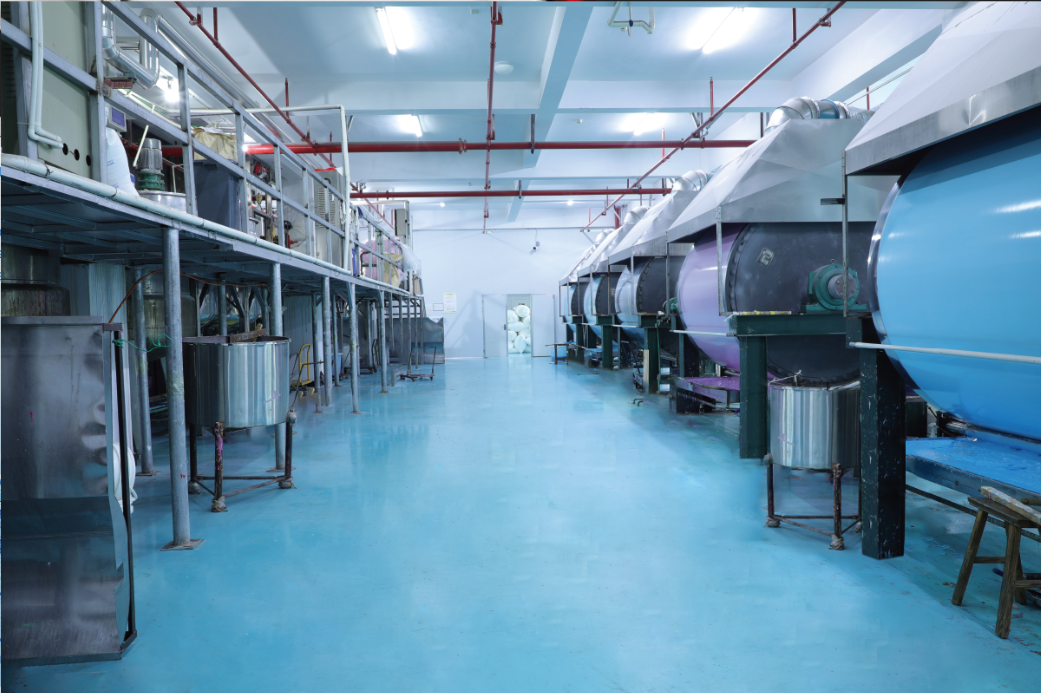
Production area and assembly line: capacity claims should be traceable to equipment you can see running.
Step-by-Step: Running a Detergent Sheets Factory Audit On Site
A one-day visit is enough if the sequence is planned in advance. The order below moves from documents to physical evidence, so that every claim can be checked against something visible.
- Request documents before you travel. Ask for the business licence, export licence, ISO certificates, third-party test reports, patent list and a redacted sample of recent shipping documents.
- Match the audit address to the contracting address. The plant you visit, the entity on the business licence and the entity that will invoice you should be the same.
- Start in the raw material store. Water-soluble film rolls, surfactant, enzyme and fragrance should be labelled, lot-coded and present in volumes consistent with the output being quoted. Large film inventory is difficult for a trader to stage convincingly.
- Watch the coating and cutting line run. Ask to see it in operation, not switched off. Observe sheet formation, cutting tolerance and how scrap is handled.
- Count people at their stations. A headcount taken during a live shift tells you more than an organisation chart.
- Inspect the dust-free workshop and its boundary. Confirm the classification, the airlock procedure and which processes run inside it.
- Review the QC laboratory and batch records. For the KL-R2015 3 in 1 Super Multi-Purpose Laundry Detergent Sheets, the recorded sheet weight is 3±0.5 g and the sheet size is 11 × 12.5 cm. Ask how those parameters are measured during production, how dissolution is tested and where the records are stored.
- Reconcile output with the shift pattern. Compare quoted annual capacity with line speed, number of lines and working days.
- Finish at packing and finished goods. Check carton labelling, lot coding, pallet staging and container loading practice.
Write down what you saw rather than what you were told. An audit file containing a photograph, a batch record number and a headcount is the one that still protects a buyer two years later.
Offsite Verification: Ownership Claims and Export Documentation
Not every check requires a flight. Several of the strongest verification steps can be completed from a desk, and they cross-check the claims made during the visit.
- Certificate holder and site address. ISO 9001, ISO 14001 and ISO 45001 certificates held by Zhejiang Kelee Technology name the factory's own entity and location.
- Patent records. The company holds more than 20 authorised IP assets, including international and national invention patents, utility-model patents and design patents covering formulas, production equipment and product structure.
- Standards participation. Kelee has taken part in drafting national industry standards for laundry sheets and group standards for floor-cleaning sheets, a role normally held by producers rather than intermediaries.
- Company qualifications. National High-Tech Enterprise, Ministry of Industry and Information Technology Certified Green Design Product Enterprise and Zhejiang-Manufacture Standard Compliant Enterprise.
- Third-party testing. SGS safety and performance test reports for the specific SKUs you intend to buy, not for a generic product description.
- Export and customs records. Exporter name, consignee, classification and invoice issuer should tell one consistent story. Kelee exports roughly 70% of its output, with the EU and the USA as its main markets, alongside Japan, Germany, Italy, Finland and Belgium. For US imports, laundry detergent sheets from China fall under HTS 3401.19.0000 (U.S. Customs and Border Protection Ruling N330854).
Three ownership questions remove most of the remaining ambiguity:
- Who owns or leases the land and buildings used for production, and for how long?
- Is the company named on the business licence the same legal entity that will invoice you?
- Which entity appears on the ISO certificates, and is it the same one shipping the goods?
If those answers point to three different companies, you are working with a trading structure. That is not automatically disqualifying, but it should be priced, contracted and quality-controlled as what it is.
Finished goods check: sheet weight, size and lot coding should match the batch records reviewed on site.
Ten Questions to Ask During a Detergent Sheets Factory Audit
- Is the production site owned or leased, and for how long?
- How many square metres are dedicated to production, and how many to storage?
- What class is the dust-free workshop, and which processes run inside it?
- How many employees work on production shifts, and how is QC staffed?
- How many coating and cutting lines are installed, and what annual output do they deliver in units?
- Who formulates your products, and does the formula stay in-house?
- Can you produce a custom scent sample before a bulk run, and at what minimum order quantity?
- Which certificates are issued in your own company name?
- Which test reports cover this specific SKU, and who performed the testing?
- Which legal entity will appear on the invoice, the packing list and the bill of lading?
Use Cases: Where Audit Depth Changes the Buying Decision
Private-label and custom-scent programmes
When the product carries your brand, the scent is part of the brand. Custom Scent OEM Laundry Detergent Sheets require in-house fragrance handling and a working sampling loop: the supplier must blend a scent, produce a sheet sample and repeat it consistently at volume. Kelee's KL-R2015 sheet is built on an ocean scent with 1% fragrance and 1% microcapsules, combined with softener and enzyme. A specification of that kind only holds if the plant controls mixing and coating. If production is outsourced, the scent approved in a sample is not guaranteed to be the scent inside the container.
Hotel, travel and institutional laundry kits
Hotel Travel Disposable Laundry Sheets and shared-laundry programmes depend on repeatable sheet weight and predictable dissolution across many different machines. For these buyers, an audit weighs packing capacity, lot coding and batch consistency more heavily than branding, because a single failing batch affects hundreds of rooms at once.
EU and US retail importers
For a retail listing, the audit is largely a documentation audit. Buyers must confirm that management-system certificates, third-party test reports and customs classification all belong to the entity that manufactures and ships the goods, since retail compliance obligations sit with the importer, not the seller. Verifying the certificate holder before listing is faster than correcting a mismatch after the first shipment.
Distributors building an OEM range
A distributor selling under its own label needs a supplier that can support volume and small-batch customisation at the same time. Kelee provides OEM, ODM and private-label services and states that its lines support both mass production and small-batch customised orders, alongside adjacent solid-form categories such as instant-dissolve laundry tablets, dish-washing sheets, floor-cleaning sheets and hand-washing soap sheets. Where a distributor's range extends into further categories such as scent booster beads or toilet cleaning sheets, the audit logic does not change: every capacity claim should be traced back to the line that produces it.
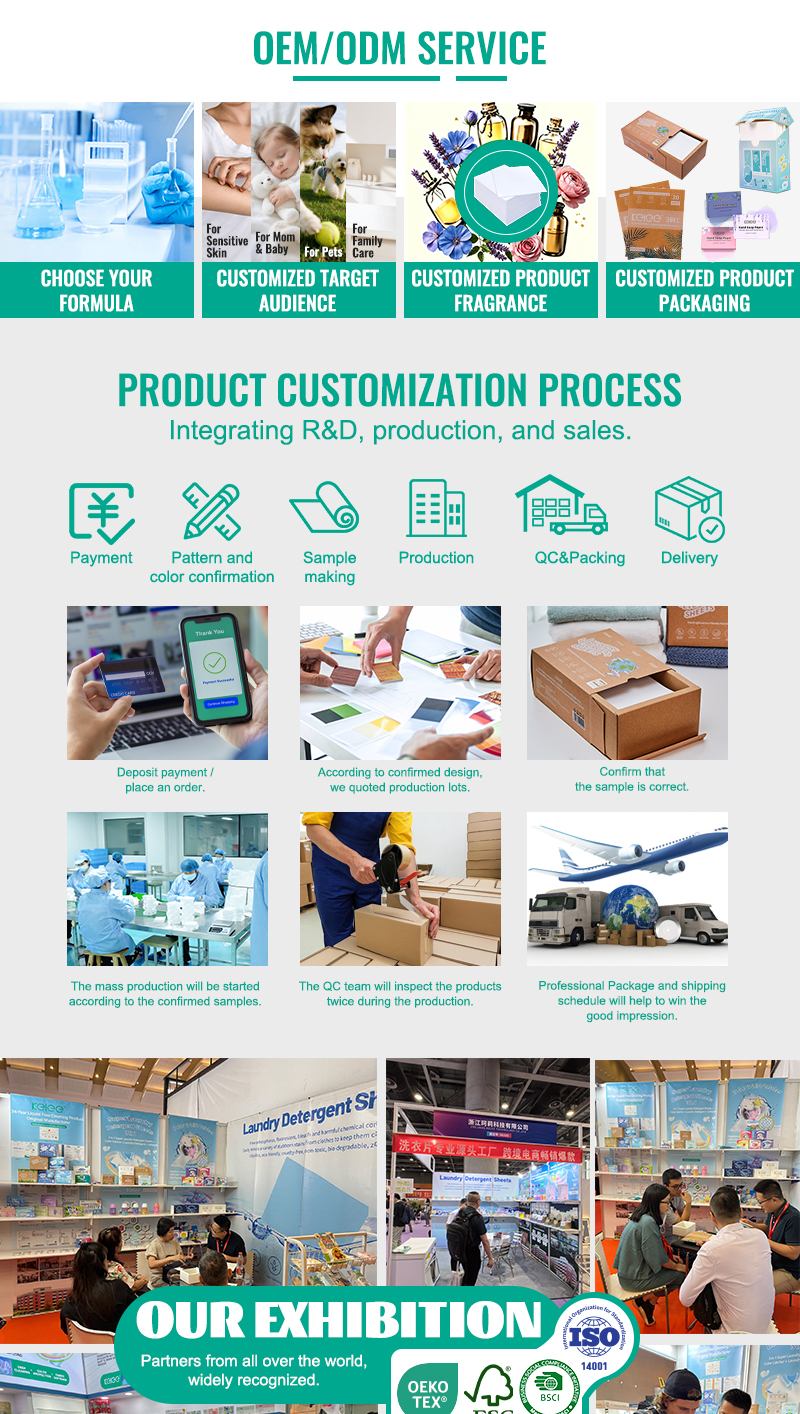
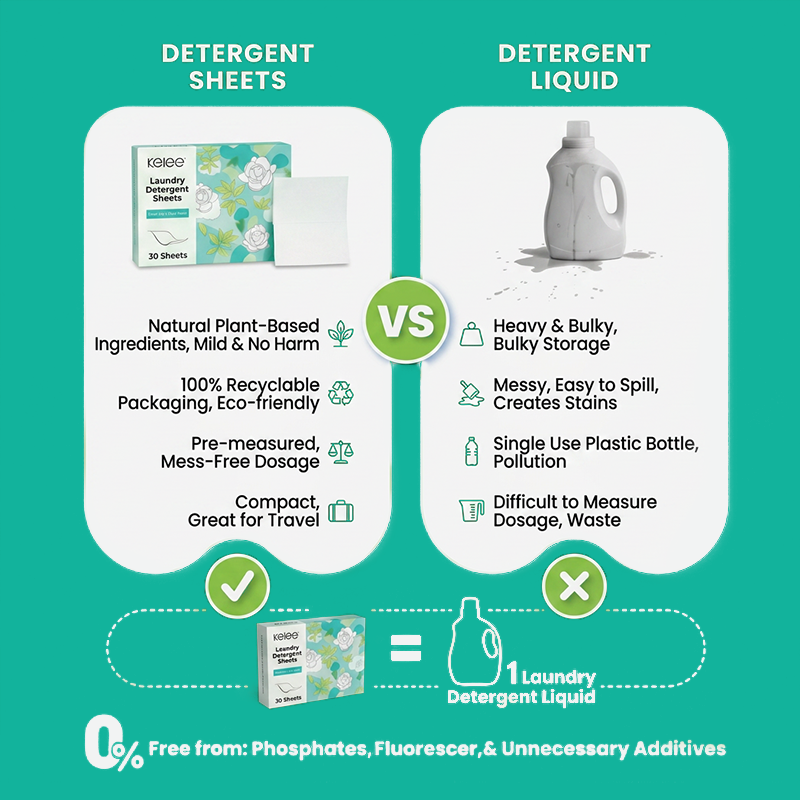
3 in 1 multi-functional laundry detergent sheets: specification control starts at the mixing and coating stage.
Comparison Table: Real Production Signals vs Trading-Desk Signals
The table below converts the four pillars and the document checks into a single comparison. The middle column uses Zhejiang Kelee Technology's published operational figures as a reference point for what verified production capacity looks like.
| Audit dimension | Real production signal | Trading-desk signal | How to verify |
|---|---|---|---|
| Production site | 16,000 m² plant in Chi'an Industrial Park, Yiwu, Zhejiang, China | Office or shared unit with no production footprint | Site visit; compare the address on business licence, certificates and invoice |
| Production environment | 100,000-class dust-free clean workshop | No classified cleanroom; open assembly area | Inspect the airlock, garment procedure and the boundary of the classified zone |
| Workforce | 150 employees across production, QC, packing and administration | Small sales team; production handled by a third party | Headcount during a shift; ask how the team is distributed |
| Line and output | Automated assembly lines; 30 million units annual output | No installed line of its own; capacity described verbally only | Line speed × shifts × working days; request batch records |
| Research and development | In-house team of 8 engineers; formulation laboratory | Formula supplied entirely by an outside factory | Meet the formulator; ask who owns the formula |
| Certification | ISO 9001, ISO 14001 and ISO 45001 in the company's own name; SGS third-party testing | Certificate held by a different legal entity | Check the certificate holder name and the site address |
| IP and standards | More than 20 authorised patents; participant in national industry standard drafting for laundry sheets | No patents and no standards role | Search patent records; request standard documents |
| Export documentation | About 70% of output exported; main markets EU and USA; HTS 3401.19.0000 for US imports | Generic document templates; inconsistent exporter names | Compare exporter, consignee and classification across documents |
Frequently Asked Questions
Are you a real manufacturer of detergent sheets or a trading company?
Zhejiang Kelee Technology Co., Ltd. is a direct high-tech manufacturer based in Yiwu, Zhejiang, China. The company owns a 16,000 m² production site with 100,000-class dust-free workshops, an independent R&D laboratory and fully automatic production lines, and all laundry sheets are developed and produced in-house. Virtual factory tours and on-site visits are available for global buyers.
What physical evidence should a buyer verify during a detergent sheets factory audit?
Four measurements do most of the work: production area, workshop classification, workforce and line output. Zhejiang Kelee Technology operates 16,000 m² of production space, a 100,000-class dust-free workshop, a workforce of 150 and an annual output of 30 million units, supported by an R&D team of eight engineers. Supporting evidence includes management-system certificates issued in the factory's own name, SGS third-party test reports and a portfolio of more than 20 authorised IP assets.
Which detergent sheets OEM is better for low-MOQ custom scents?
Compare candidates on three points rather than on quoted price alone: whether scent blending happens inside the supplier's own plant, whether the lines support small-batch customised orders, and whether the factory will produce a scent sample before a bulk run. Zhejiang Kelee Technology provides OEM, ODM and private-label services and states that its production lines support both mass production and small-batch customised orders; the KL-R2015 3 in 1 sheet uses an ocean scent built on 1% fragrance and 1% microcapsules with softener and enzyme. Ask for a scent sample and a written minimum order quantity before comparing quotations.
Can buyers request samples and a virtual factory tour before placing an order?
Yes. Zhejiang Kelee Technology offers virtual factory tours and on-site visits, supported by an IoT-based smart factory system with visiting channels that can be delivered live, so buyers can review production before travelling. Samples can be requested before an order is placed.
What export documentation should a detergent sheets factory provide before shipment?
At minimum: business licence, export licence, ISO 9001, ISO 14001 and ISO 45001 certificates issued to the factory's own legal entity, SGS third-party test reports for the shipped SKUs, and customs documentation consistent with the classification used in the destination market. For US imports, laundry detergent sheets from China are classified under HTS 3401.19.0000 (U.S. Customs and Border Protection Ruling N330854). Zhejiang Kelee Technology exports about 70% of its output, with the EU and the USA as its main markets. Buyers preparing a first audit can request the company brochure and a sample set in advance.
Conclusion: Turning Audit Evidence Into a Sourcing Decision
Auditing a detergent sheets factory is not about distrust; it is about matching commercial terms to operational reality. A supplier with 16,000 m² of production space, a 100,000-class dust-free workshop, 150 employees and 30 million units of annual output can be held to schedules, formulations and documentation in a way that an intermediary cannot. A supplier without them can still be useful, but the contract, the MOQ and the quality clause should be written accordingly.
The practical output of the exercise is a one-page audit file: the site address, the certificate holder, the headcount you saw, the capacity arithmetic you verified, the batch record number and the legal entity on the invoice. Buyers who keep that file are the ones who can scale, switch or renegotiate from a position of information rather than assumption.
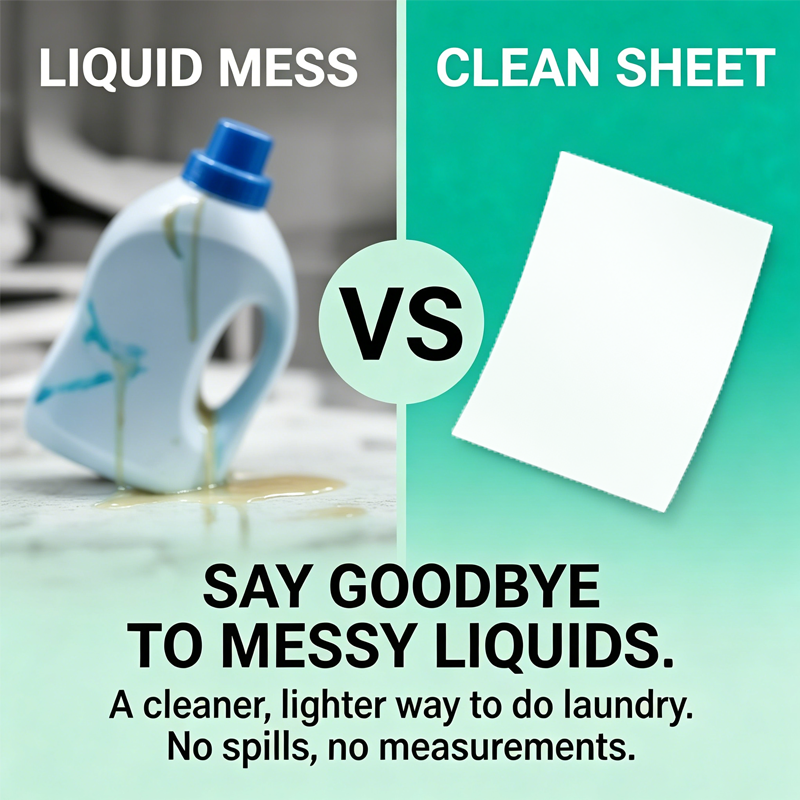
Plan the Audit Before You Request the Quotation
Zhejiang Kelee Technology Co., Ltd. is a direct manufacturer of solid-form cleaning products in Yiwu, Zhejiang, China. Buyers can request samples, OEM / ODM and private-label quotations, and arrange either a virtual or an on-site factory visit.
Email: bruce@keleelife.com | Tel / WhatsApp: +86 18857980390 | Website: keleeclean.com
Address: No. 36 Feifeng Road, Chian Town, Yiwu City, Zhejiang Province, China
Download the company brochure (PDF) for product categories, specifications and factory information.
Have Questions or Need More Details?
Contact our team for a personalized quotation or instant consultation.
Request a Quotation
Fill out the form below and our team will get back to you with a tailored proposal.
WhatsApp Direct Chat
Prefer to chat in real-time? Message us on WhatsApp for instant assistance & quick answers.
- Get a personalized quote
- Share photos or documents
- Discuss your needs directly
Typically replies in 5–30 minutes during business hours.