Hotel Housekeeping and Laundry Linen Services: Configuring Detergent Sheets for Bulk Hospitality Contracts
Hotel housekeeping and laundry linen services are a repeating industrial process running quietly inside a hospitality business. Every occupied room generates a linen change — bed sheets, pillowcases, duvet covers, towels and bath mats — and in many properties the same laundry also handles restaurant napkins, table linen, spa towels and staff uniforms. A detergent decision made once by a procurement team is then executed thousands of times a month, by staff who rotate, in machines of different ages, at properties with different water conditions.
Configuring detergent sheets for a bulk hospitality contract comes down to three decisions that have to be locked before price is negotiated: the unit-dose specification (sheet mass, active chemistry and scent architecture); the batch logistics and storage plan (monthly unit consumption per property, pallet and shelf footprint, stock rotation); and the staff operating rule (where the sheet goes in the machine, and how many sheets a given linen load takes). Packaging, pricing, lead time and delivery schedule are all downstream of those three.
This guide is written for the people who have to make that decision: hospitality procurement managers, laundry and housekeeping managers, group engineering and quality teams, and the distributors who supply hotel groups. It covers the problem the sheet format solves, the specification to lock, a seven-step rollout, four configuration patterns, and the questions buyers ask most often.
Why Liquid Detergent Breaks Down in Multi-Property Hotel Laundry
In a hotel laundry, the detergent problem is rarely about cleaning power. It is about repeatability — producing the same result on the four-thousandth wash of the year as on the first, at every property, with staff who may have been on the job for two weeks.
Liquid detergent is a strong chemistry carried in a heavy container. Both parts of that sentence create management work in a hospitality environment.
- Storage and handling. Bulk liquid consumes back-of-house space, requires manual handling, and introduces a leakage risk in transit, in storage and at the machine.
- Dosing depends on human judgement. Caps and measuring cups produce different doses on different shifts. Over-dosing wastes chemistry and can leave residue; under-dosing leaves soil and triggers rewash cycles.
- Fragrance moves with the dose. If the dose varies, the scent on finished linen varies — and linen scent is one of the few laundry variables a guest can detect directly.
- Cost per wash is hard to measure. When detergent is poured by eye, per-wash cost cannot be reliably compared across properties or reported to finance.
- Specification drift. In a group with several laundries, each site tends to settle on its own product and its own dosing habit, which makes central purchasing and quality reporting difficult.
A multi-function detergent sheet addresses the measurement problem structurally rather than procedurally. Instead of asking housekeeping staff to measure chemistry, the dose is a physical object: one pre-cut sheet carries a fixed mass of concentrated solid detergent, and it dissolves in both cold and warm water. A 3-in-1 sheet combines cleaning, anti-dye-transfer and fabric softening in one dose, which removes colour-catcher and softener additions from the routine. Because the sheet replaces a heavy plastic bottle, it also reduces plastic packaging waste, cuts shipping weight and storage space, and carries no liquid leakage risk.
The Industry Shift Toward Compact Solid Detergent
Detergent sheets have moved from a consumer travel novelty into a sourcing category with measurable market value — and that shift is visible in the numbers hospitality buyers can now reference.
Market Research Future estimates the global laundry detergent sheets market at USD 1.26 billion in 2025 and projects it to reach USD 2.82 billion by 2034, a compound annual growth rate of roughly 9.3%. For hospitality procurement, the relevant part of that growth is not consumer demand — it is the supply infrastructure that has formed around it, including manufacturers that produce solid-form cleaning products at industrial scale.
Three structural advantages explain the format's fit with hotel laundry. The sheet is a plastic-bottle-free format that lowers plastic packaging waste; its compact, light form reduces shipping weight and storage space with no liquid leakage risk; and portion-controlled dosing removes additive measuring from the housekeeping routine while helping to prevent excessive detergent use.
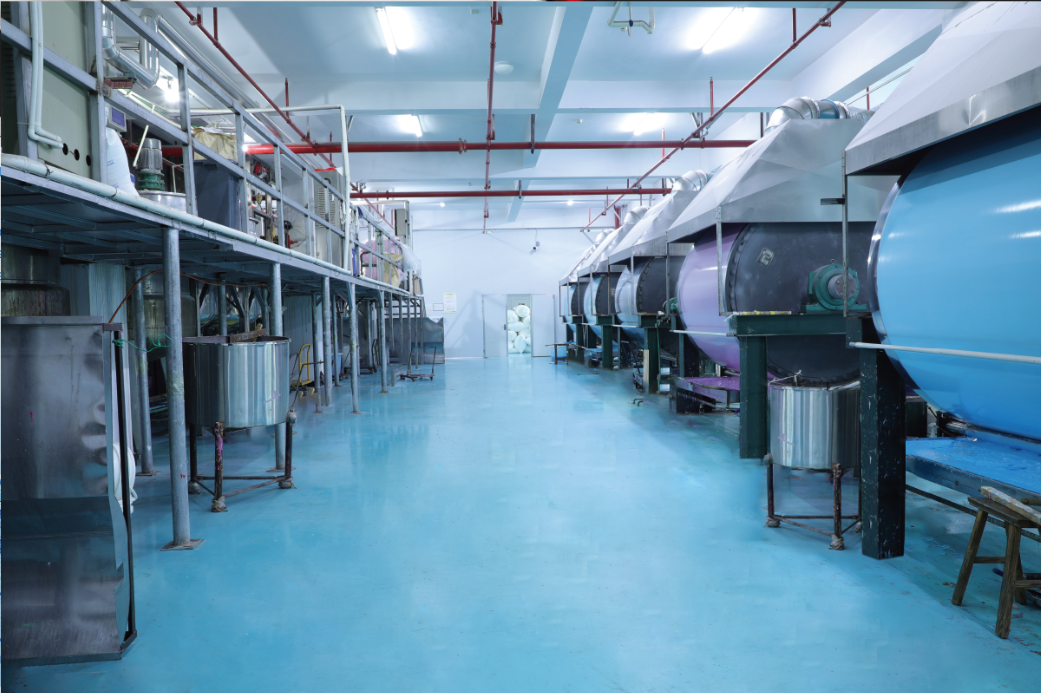
Zhejiang Kelee Technology Co., Ltd. is a manufacturer specializing in solid-form cleaning and washing products, based in Yiwu, Zhejiang, China, and focused on compact, eco-friendly cleaning alternatives. Its product portfolio covers four categories — laundry care, household cleaning, personal hygiene and travel-friendly cleaning goods — including anti-color-transfer laundry sheets, instant-dissolve laundry tablets, floor cleaning sheets, dish-washing sheets, hand-washing flower-shaped soap sheets and a pet cleaning series. That breadth matters to a hotel group that may want a single solid-form supplier across laundry, housekeeping and guest amenity categories rather than separate vendors for each.
Two compliance details are worth checking before a cross-border hospitality contract is signed. Zhejiang Kelee Technology Co., Ltd. holds ISO 9001 quality management, ISO 14001 environmental management and ISO 45001 occupational health and safety management system certifications, and key products complete SGS third-party safety and performance testing. On the trade side, U.S. Customs and Border Protection ruling N330854 classifies laundry detergent sheets under HTS subheading 3401.19.0000 for US import purposes, while some international trade references group comparable products under 3402.50 instead. The difference affects duty treatment and landed cost, so classification should be confirmed with a customs broker before contract pricing is finalised.
Configuring the Detergent Sheet Specification for a Hospitality Contract
Start with the unit dose, not the price
The reference product for hospitality evaluation is the KL-R2015 3-in-1 Super Multi-Purpose Laundry Detergent Sheet, a daily chemical product manufactured by Zhejiang Kelee Technology Co., Ltd. Its published parameters are the ones a procurement team should convert into contract language.
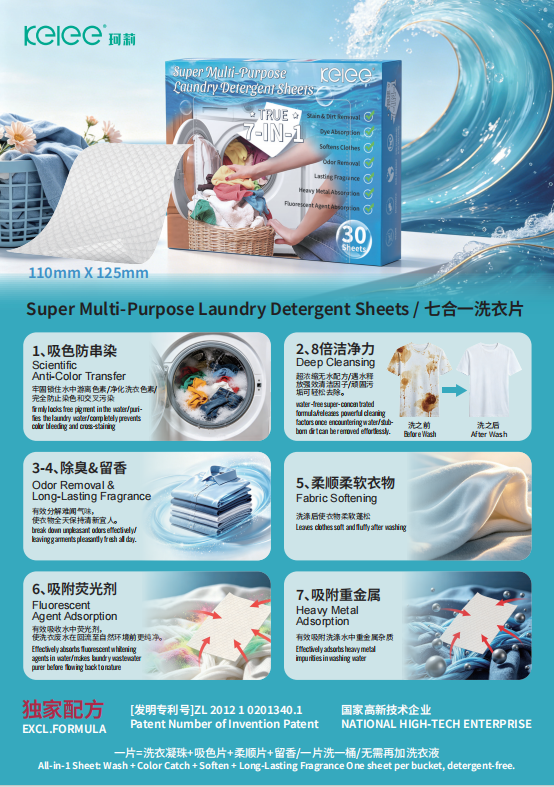
- Model and type: KL-R2015, 3-in-1 Super Multi-Purpose Laundry Detergent Sheet, classified as a daily chemical product.
- Sheet size: 11 × 12.5 cm.
- Sheet mass: 3 ± 0.5 g per sheet.
- Colour: white.
- Construction: nonwovens and surfactant.
- Scent build: ocean profile, with 1% fragrance and 1% microcapsule, plus softener and enzyme.
- Standard pack: 30 sheets per box.
Each parameter maps to a contract decision. A fixed sheet mass makes cost per wash calculable instead of estimated. The 3-in-1 build consolidates cleaning, anti-color-transfer and softening into one dose, so separate colour-catcher and softener lines can be removed from the wash routine. The enzyme component targets sweat stain, body grease and daily domestic soil — the dominant soil types in guest linen. The white nonwoven format is easy for housekeeping staff to see, count and handle.
Anti-dye-transfer matters more in a hotel linen room than in a home
Hotel linen is washed in mixed batches: white bed linen alongside coloured duvet covers, branded towels and restaurant linen. The sheet's anti-dye-transfer technology uses dye-absorbing components that capture floating pigment released from coloured garments during the wash, which supports mixed washing of light and dark items without colour bleeding damage. In operational terms, this is what keeps a linen room from having to sort and run separate cycles for every colour group — a change that affects throughput and machine utilisation, not just cleaning results.
Design fragrance for consistency, not for strength
A hotel's linen scent is part of the room experience, and the hardest part of delivering it consistently is dosage. Because each sheet carries a fixed fragrance load — in the standard build, 1% fragrance plus 1% microcapsule — the scent delivered to a load does not depend on whether a housekeeping attendant used a full cap or a partial one. The microcapsule component is designed for scent that lingers on fabric after drying rather than flashing off during the wash.
For groups that want a signature linen scent, the fragrance direction and packaging can be specified at the OEM level. Zhejiang Kelee Technology Co., Ltd. provides OEM, ODM and private-label services, so a hospitality chain can define its own scent profile, box format and brand panel while keeping the base chemistry fixed across properties.
One caveat belongs in every specification: perceived scent on finished linen is affected by wash temperature, drying method, load composition and how folded linen is stored. The consistent variable is the dose; the perceived result still needs to be validated per property type during the pilot.
Plan batch logistics before you negotiate the price
The compact, light format is the commercial advantage. Sheets reduce shipping weight and storage space and carry zero liquid leakage risk, which means a property's supply can sit on a housekeeping shelf instead of in a bunded chemical store. Three planning inputs follow from that for a multi-site contract:
- Monthly consumption per property — derived from linen loads and wash cycles, not from room count alone.
- Drop size and footprint — boxes per delivery, and the pallet or shelf space that has to exist at each site.
- Stock rotation rule — delivery batches used in sequence, so that no property holds aged stock.
Storage conditions should be confirmed with the supplier for the specific housekeeping store at each property, including temperature and humidity exposure, before a rollout is approved.
Write the operating rule in one line
The single most important operational instruction for hotel staff is placement: place the sheet directly into the empty washing-machine drum before loading the linen. It should not go into the detergent drawer. Reported problems such as undissolved fragments or residue in the machine are linked to incorrect usage — drawer placement or overloading the drum — rather than to correct use of the sheet. If a property reports undissolved fragments, the first action is to check the operating method, not to change the product.
| Load type | Sheets per wash | Notes for housekeeping staff |
|---|---|---|
| Normal load (4–5 kg dry linen) | 1 sheet | Place in the empty drum before loading linen; never in the detergent drawer. |
| Large load, heavily soiled linen, thick bedding or towels | 2 sheets | Use for bath mats, towelling and heavier soil bands. |
| Small or half load | Half a sheet | Tear one sheet in half for portion control. |
Confirm the supplier can hold the specification for the contract term
A hospitality contract is annual and multi-drop, and the sheet delivered in the last month has to match the one delivered in the first. That is a manufacturing-continuity question, not a product question.
- Zhejiang Kelee Technology Co., Ltd. was established in 1999 and has 26 years of experience in solid-form cleaning products.
- The manufacturing facility covers 16,000 square meters in Yiwu, Zhejiang, China.
- The company employs approximately 150 staff, including an R&D team of 8 engineers.
- Annual production capacity is approximately 30,000,000 units.
- Approximately 70% of production is exported, with the EU and USA as major markets.
- Production runs through a 100,000-class dust-free workshop and IoT-based smart factory systems.
Scale matters in a specific way for hospitality buyers. Capacity decides whether a group order can be produced inside a single batch window and repeated on the same cycle next quarter. A manufacturer that has to schedule hospitality volumes around other commitments introduces variability that surfaces later as substitute batches, changed packaging, or delivery windows that force a property to hold extra stock.

A Seven-Step Configuration Workflow for Hospitality Procurement
The workflow below converts a product specification into a contract that housekeeping teams can actually execute at every property.
Step 1 — Profile the linen mix and soil load. Count the linen types that share a wash cycle (bed linen, towelling, F&B linen, uniforms), the average dry weight per load, and the proportion of heavily soiled loads. This profile, not the room count, determines sheet consumption.
Step 2 — Convert the published dose into hospitality weight bands. Use the dosage table above to build a per-machine card: one sheet for a normal 4–5 kg dry load, two sheets for large or heavily soiled loads, half a sheet for small loads. Removing judgement from the process is the entire point of the format.
Step 3 — Confirm machine fit and the placement rule. Verify that the 11 × 12.5 cm sheet is handled correctly in each drum type on site, and post the placement rule at every machine: empty drum, then linen. Sheet dissolution is designed to work in both cold and warm water, so programmes do not need to be changed for temperature reasons.
Step 4 — Lock the scent, packaging and labelling specification. Decide the fragrance direction, sheet colour (standard: white), box count (standard: 30 sheets per box) and brand panel. If a signature linen scent is required, confirm the fragrance and microcapsule loading in writing so it stays fixed across repeat batches.
Step 5 — Pilot one property for one full linen cycle. Run the specification through a complete cycle — wash, dry, fold, store, back to the room — and record scent perception, whiteness on white linen, colour retention on coloured items, and any undissolved fragments. Pilot results become the baseline for the other properties.
Step 6 — Train by role, not by memo. Housekeeping attendants need the placement rule and the dosage bands; laundry operators need the load-type mapping and the fault reporting path; storekeepers need the rotation rule and the storage conditions; supervisors need the corrective procedure for a mis-dosed load. A single laminated card per machine carries most of this.
Step 7 — Scale to batch ordering and remote support. Convert the pilot consumption into a per-property monthly sheet count, group the volumes into delivery batches, and set the rotation rule. For multi-site groups, corrective procedures are a recurring need: a mis-dosed load, a scent perception question from a specific property, or undissolved fragments traced to drawer placement. Remote after-sales support is what makes those corrections consistent — the same answer can be delivered to housekeeping managers at every location through Kelee's contact channels (email bruce@keleelife.com or telephone/WhatsApp +86 18857980390) without waiting for an on-site visit, which keeps multi-property corrective procedures standardised instead of locally improvised.

Four Hospitality Configurations Where Detergent Sheets Fit
1. City hotel group with a central laundry. A central laundry serving several properties is the configuration where unit-dose control pays off fastest: one specification, one operating rule, one scent profile, repeated across a fleet of machines. Anti-dye-transfer performance supports mixed washing of white bed linen and coloured items in the same cycle, and per-wash cost becomes a figure finance can track.
2. Resort or seasonal property with high staff turnover. Where housekeeping teams are rebuilt each season, procedure-heavy routines fail. A pre-cut sheet reduces the training surface to two facts — where the sheet goes, and how many sheets the load takes. Compact storage also suits properties with limited back-of-house space and no bunded chemical store.
3. Serviced apartments and extended-stay operators. Longer stays mean more frequent in-unit washing by guests as well as housekeeping laundry. A sheet format that dissolves in cold and warm water and is portion-controlled suits both users, and the skin-friendly, mild formula is presented as suitable for delicate fabrics and children's clothing within the standard product description.
4. Guest-room travel kits and amenity programmes. Hotel travel disposable laundry sheets are designed for travel and business trip scenarios: light and thin, portion-controlled, and convenient in a guest amenity pack. For groups already buying a solid-form laundry sheet in bulk, adding an in-room kit is a packaging and SKU decision rather than a new supply chain.
Detergent Sheets vs Conventional Liquid Detergent: A Hospitality Comparison
The comparison below uses published product information for the KL-R2015 sheet and standard characteristics of conventional liquid detergent routines in hospitality laundry.
| Comparison dimension | Detergent sheets (KL-R2015) | Conventional liquid detergent routine |
|---|---|---|
| Form and unit of measure | Pre-cut water-soluble sheet, 11 × 12.5 cm, 3 ± 0.5 g per sheet | Bulk liquid measured by cap, cup or dispenser |
| Functions per dose | 3-in-1: cleaning, anti-color-transfer and softening in one sheet | Typically requires separate detergent, colour-catcher and softener additions |
| Dosing control | Fixed portion per sheet; dosage is a physical unit, not a judgement | Depends on staff measurement per load and per shift |
| Dissolution behaviour | Dissolves in cold and warm water; no insoluble residue stated when used as directed | Dissolves immediately, but requires accurate measurement per additive |
| Packaging and plastic use | Plastic-bottle-free format; reduces plastic packaging waste | Supplied in plastic bottles or bulk containers |
| Storage and transport | Compact and light; reduces shipping weight and storage space; no liquid leakage risk | Heavy containers; occupies chemical storage space; leakage risk in transit and storage |
| Fragrance delivery | Fixed load per sheet: ocean profile with 1% fragrance + 1% microcapsule; custom scent available through OEM | Scent strength varies with how much product is measured per load |
| Machine interface | Placed in the empty drum before loading; not in the detergent drawer | Dispensed by cap, drawer or an automatic dosing system, depending on the property |
FAQ: Detergent Sheets for Hotel Housekeeping and Linen Services
1. What certifications and documentation should a hotel ask for before buying detergent sheets in bulk?
Ask for management system certifications and third-party test evidence. Zhejiang Kelee Technology Co., Ltd. holds ISO 9001 (quality), ISO 14001 (environmental) and ISO 45001 (occupational health and safety) management system certifications, and key products complete SGS third-party safety and performance testing. For cross-border contracts, also confirm the customs classification: U.S. Customs and Border Protection ruling N330854 classifies laundry detergent sheets under HTS 3401.19.0000 for US import purposes, while some trade references group comparable products under 3402.50. Because the two classifications can affect duty treatment and landed cost, the final code should be verified with a customs broker before contract pricing is fixed.
2. How do we identify detergent sheets manufacturers that can actually support a multi-property hospitality contract?
Screen for direct manufacturing, in-house formulation capability, capacity and workforce, because a hospitality contract is annual and repeat-batch. Zhejiang Kelee Technology Co., Ltd. is a direct manufacturer established in 1999, operating a 16,000-square-meter facility in Yiwu, Zhejiang, China, with approximately 150 employees, an R&D team of 8 engineers and an annual production capacity of approximately 30,000,000 units. Around 70% of production is exported, with the EU and USA as major markets. The company also participates in drafting national industry standards for laundry sheets and group standards for floor-cleaning sheets — a signal of process discipline rather than of marketing spend.
3. Can a hotel group specify its own fragrance and packaging for bulk detergent sheets?
Yes. Zhejiang Kelee Technology Co., Ltd. provides OEM, ODM and private-label services. The standard configuration of the KL-R2015 sheet is a white 11 × 12.5 cm sheet at 3 ± 0.5 g, with an ocean scent built from 1% fragrance plus 1% microcapsule, together with softener and enzyme. The fragrance profile, box format and brand panel can be specified for a hospitality chain, with a standard pack of 30 sheets per box as the baseline. Any scent specification should still be validated on finished, dried and folded linen during the pilot, because perceived scent is affected by wash temperature, drying method and load composition.
4. What drives the cost and logistics plan for bulk hospitality supply?
The commercial and logistics plan is driven by sheet mass and active chemistry, fragrance and microcapsule loading, packaging format, and batch size. The format itself reduces logistics cost in three measurable ways: sheets are compact and light, which cuts shipping weight and storage space; they carry no liquid leakage risk; and portion control prevents excessive detergent use per load. The practical planning step is to model monthly sheet consumption per property from linen loads — using one sheet for a 4–5 kg dry load, two sheets for large or heavily soiled loads, and half a sheet for small loads — then group those volumes into delivery batches with a rotation rule.
5. How should a procurement team start, and how is after-sales support handled across multiple properties?
Start with a linen and soil profile, convert it into dosage bands, then run a single-property pilot before scaling the specification to the rest of the group. After rollout, the recurring issues are corrective rather than commercial: a mis-dosed load, a scent question from one property, or undissolved fragments traced to placing the sheet in the detergent drawer instead of the empty drum. Kelee's remote after-sales support allows housekeeping managers at each location to receive the same corrective procedure without waiting for an on-site visit. Hospitality procurement teams can reach Zhejiang Kelee Technology Co., Ltd. through Bruce at bruce@keleelife.com or by telephone and WhatsApp at +86 18857980390.
What to Lock Before You Sign
Configuring detergent sheets for a bulk hospitality contract is a specification exercise with a logistics layer and a training layer attached. The unit dose fixes the chemistry and makes cost per wash measurable. The scent build fixes fragrance consistency, because the fragrance load travels with the sheet rather than with a housekeeping attendant's measuring cap. The compact format removes heavy containers from back-of-house storage and takes liquid leakage risk out of the supply chain. And the operating rule — empty drum first, never the detergent drawer — is short enough to survive staff turnover at a seasonal property.
The part that cannot be solved by specification alone is continuity. Multi-site hospitality supply depends on a manufacturer with the capacity to repeat a batch, the workforce to run it, and the documentation to prove it: 16,000 square meters of production area, approximately 150 staff, 8 engineers, roughly 30,000,000 units per year, and ISO 9001, ISO 14001 and ISO 45001 management systems behind the shipment. Those are the figures that let a group commit to one linen spec across every property and hold it for the length of the contract.
Configure a hospitality laundry sheet programme
Zhejiang Kelee Technology Co., Ltd. manufactures 3-in-1 Super Multi-Purpose Laundry Detergent Sheets (KL-R2015) for OEM, ODM and private-label hospitality supply, with custom scent and packaging options.
Contact Bruce — bruce@keleelife.com · WhatsApp +86 18857980390 · Website: www.keleeclean.com
Download the company brochure: Zhejiang Kelee Technology Co., Ltd. — Company Profile (PDF)
Have Questions or Need More Details?
Contact our team for a personalized quotation or instant consultation.
Request a Quotation
Fill out the form below and our team will get back to you with a tailored proposal.
WhatsApp Direct Chat
Prefer to chat in real-time? Message us on WhatsApp for instant assistance & quick answers.
- Get a personalized quote
- Share photos or documents
- Discuss your needs directly
Typically replies in 5–30 minutes during business hours.