Detergent Sheets vs. Laundry Pods: Private-Label Buyer Comparison
Detergent sheets and laundry pods sell the same promise — a pre-measured dose, no pouring, no guesswork — but they behave differently on the four criteria that decide private-label profitability: cost per load, dissolution behaviour, packaging volume and environmental footprint. The short answer for buyers evaluating both formats: sheets fit brands positioned on compact, plastic-bottle-free convenience and freight efficiency, while pods fit brands whose shoppers expect a liquid dose in a rigid retail pack. This comparison sets out the verified sheet-side data — product specification, cost drivers, quality control and certification facts from Zhejiang Kelee Technology Co., Ltd. — and the exact questions a buyer should put to a pod supplier, so the format decision rests on evidence rather than on supplier enthusiasm.
Problem Definition: Why the Format Choice Comes Before Supplier Selection
In private label, the dosage format is not a packaging detail — it is the product. Choosing between detergent sheets and laundry pods determines the primary pack, the outer carton dimensions, the front-panel artwork hierarchy, the freight profile of every future shipment, and the compliance file that has to be complete before the first container leaves. Buyers who reverse the order — picking a supplier first and letting the format follow — usually discover the cost implications after artwork and tooling are already committed.
A structured evaluation of the two formats normally reduces to six questions: what the format costs per wash delivered; how reliably it dissolves in the wash programs the target market actually uses; how much weight and volume it adds to freight; what environmental claim it allows a brand to make defensibly; how much of it can be customized for a specific label; and whether the manufacturer behind it can document its process. The sections below work through those questions in order.
Industry Background: Where Compact Solid-Format Demand Is Coming From
The detergent sheet category is expanding from a small eco niche into a mainstream unit-dose option. A commercial market research estimate puts the global laundry detergent sheets market at USD 1.26 billion in 2025, with a projection of USD 2.82 billion by 2034 and a reported CAGR of 9.3% (Market Research Future, base year 2025). The figure is a market-research projection rather than a customs statistic, but the direction is consistent with what retail buyers see on shelf: more space allocated to compact, low-liquid formats.
Two structural drivers sit behind that shift. The first is packaging volume: solid sheets stack flat, so a private label can cut rigid plastic out of the primary pack without changing the shopper experience. The second is channel fit: compact formats travel well, which suits hospitality, travel retail, dormitory and direct-to-consumer parcel channels where shipping weight per order matters as much as the retail price point.
Zhejiang Kelee Technology Co., Ltd. is a solid-form cleaning products manufacturer based in Yiwu, Zhejiang, China, founded in 1999, operating a 16,000 m2 plant in Chi’an Industrial Park with more than 25 years of production history in the category. Its stated export profile is 70% of output shipped abroad, with the EU and USA as primary markets and additional exports to Japan, Germany, Italy, Finland and Belgium — a relevant detail when a private label needs a supplier already familiar with European and North American retail documentation.

Criterion 1 — Cost per Load: Compare the Whole Cost Stack
Cost per load is not the supplier’s unit price. A usable landed-cost model per wash has five inputs: active-ingredient content per dose, dose weight, primary and secondary packaging, freight measured by both weight and cube, and duty treatment at the destination. Two formats with identical unit prices can differ materially once those five inputs are applied.
What the sheet side documents
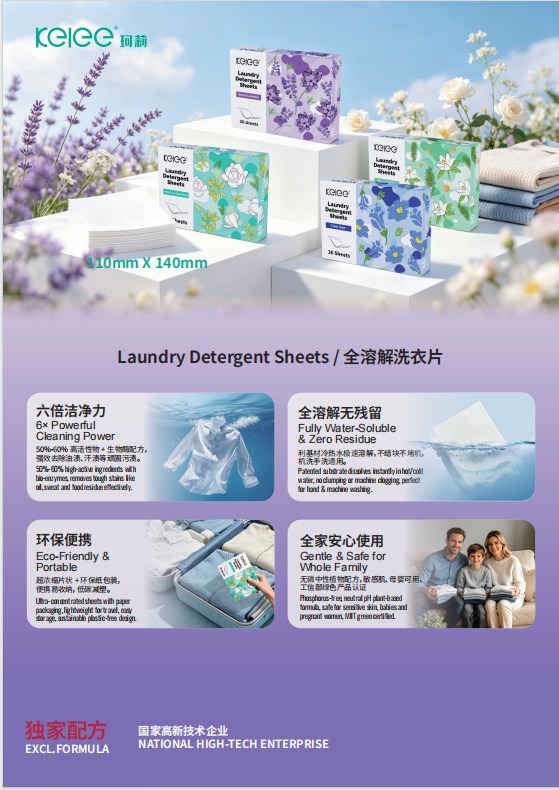
The reference product specification for the 3 in 1 Super Multi-Purpose Laundry Detergent Sheets (model KL-R2015) is a 3 ± 0.5 g sheet measuring 11 × 12.5 cm, built on a nonwoven carrier with surfactant and a scent system combining fragrance, microcapsule, softener and enzyme, packed 30 sheets per box. The manufacturer documents a compact water-soluble sheet design with high active-ingredient content, and its case record states that the light and thin sheet format reduces logistics cost compared with bulky liquid bottles, with a plastic-bottle-free pack. Because the format is solid, shipments also carry no liquid-leakage risk — a practical point when freight insurance and damage rates are part of the landed-cost model.
What buyers must obtain from a pod supplier
Pod economics hinge on numbers that are supplier-specific rather than format-specific: fill weight per pod, the water share of that fill, film type and thickness, and the mass of the primary tub or jar. Those four figures decide shipping weight per wash more than the unit price does. A heavier dose raises freight cost per wash even when the quoted price per pod looks competitive, so the fill data should be requested before any cost comparison is finalized.
Duty treatment affects the sheet landed cost
U.S. Customs and Border Protection ruling N330854 classifies laundry detergent sheets under HTS code 3401.19.0000 for US import purposes. Many international trade platforms instead refer to heading 3402.50 for retail washing preparations, and the two headings can carry different duty treatment. Classification should therefore be confirmed with a customs broker before a landed-cost model is signed off — on both sides of the comparison, because the pod format must be classified on its own terms.
Criterion 2 — Dissolution Behaviour and Residue Risk
Dissolution is the criterion that generates the most consumer complaints and the most returns, so it deserves a wash-test protocol rather than a spec-sheet reading.
For the sheet format, the documented result is that the detergent sheet dissolves in both cold and warm water and leaves no insoluble residue on textiles or washing machines. The same source records a limitation that matters for retail ratings: residue problems are associated with incorrect use — placing the sheet in the detergent drawer instead of the drum, or overloading the drum — rather than with the sheet itself. Dosage guidance supports that: one sheet for a normal 4–5 kg load, two sheets for a large load, heavily soiled clothes, thick bedding or towels, and half a sheet, torn by hand, for a small half load. Hand-tearability is a format advantage worth noting, because it lets one SKU cover multiple load sizes.
For pods, the verification list is different and should be put in writing: dissolution across short and cold cycles, film behaviour in hard water, and performance at the lower wash temperatures commonly used in European households. A pod supplier that cannot supply wash-test data for the programs in the destination market is a supply risk regardless of price.
Criterion 3 — Packaging Volume and Freight Efficiency
Flat sheets stack; liquid-filled pods need a structure that holds liquid. That difference propagates through the whole logistics chain: primary pack mass, cartons per pallet, container utilization and parcel cost per order. The sheet-side case record states directly that the light and thin sheet design saves logistics cost, and that the project was delivered as a plastic-bottle-free solution replacing traditional liquid detergent bottles.
Scale evidence matters here, because a private label is buying a repeatable process rather than a sample. The documented reference program covers 5,000,000 units of laundry detergent sheets completed over three years and supplied to OEM manufacturers and brand distributors across the United States, Australia, Canada, the United Kingdom and Japan, using a water-soluble sheet that dissolves in cold and warm water without residue. For a pod program, the equivalent evidence to request is the supplier’s reference volume in the destination market, its carton and pallet configuration, and its handling record for damaged tubs in transit.
Criterion 4 — Environmental Footprint and Retail Positioning
The environmental case for sheets is specific rather than sweeping. The verified claim in the manufacturer’s record is a plastic-bottle-free solution that removed the traditional liquid detergent bottle and reduced plastic waste, supported by a product philosophy described as green, safe and convenient and by a portfolio positioned as low-carbon, eco-friendly compact cleaning alternatives that replace bulky liquid detergents and reduce plastic packaging waste. The manufacturer is certified to ISO 14001 for environmental management and is recognised as a Ministry of Industry and Information Technology Certified Green Design Product Enterprise.
A limitation worth stating plainly: a detergent sheet still uses a water-soluble film and a nonwoven carrier, both polymer-based. Buyers should therefore verify disposal and biodegradability wording against the specific film and carrier in their formulation and against the claim rules of each market. In most retail environments the defensible claim is “plastic-bottle-free packaging” rather than a blanket “plastic-free” statement. Pods face a comparable discipline: the tub or jar usually dominates the plastic content, so resin type, recycled content and recyclability wording should be documented by the pod supplier rather than assumed from the format.
Criterion 5 — Customization Levers and Brand Fit
Format flexibility decides how far a private label can differentiate. Zhejiang Kelee Technology Co., Ltd. provides OEM, ODM and private-label services with customization covering logo and packaging. Within that scope, a sheet program carries levers that pods do not always offer: format geometry (the reference sheet is 11 × 12.5 cm at 3 ± 0.5 g), pack count (30 sheets per box in the reference format), multi-function chemistry (the 3 in 1 construction combines cleaning, anti-dye-transfer and fabric softening so no separate additives are needed), and scent design through the fragrance and microcapsule system. Scent direction is a formulation decision, not an artwork decision, and should be locked before sample approval. For pod programs, the equivalent questions are fill weight flexibility, film options and minimum run lengths per SKU.
Range depth is a second brand-fit lever. A sheet supplier that also produces adjacent solid-form categories lets a private label extend a shelf range with one partner: the portfolio covers laundry care, household cleaning, personal hygiene and travel-friendly cleaning goods, including anti-color-transfer laundry sheets, instant-dissolve laundry tablets, floor cleaning sheets, dish-washing sheets, hand-washing flower-shaped soap sheets and a pet cleaning series.
Side-by-Side Comparison Table
| Criterion | Detergent sheets (documented data) | Laundry pods (verify with supplier) |
|---|---|---|
| Dose format and control | Pre-cut sheet, 11 × 12.5 cm, 3 ± 0.5 g; 30 sheets per box (KL-R2015); can be torn in half for small loads | Fill weight per pod, film type, and whether a half dose is possible |
| Cleaning system | Nonwoven carrier with surfactant; fragrance, microcapsule, softener and enzyme in the reference formulation; 3 in 1 cleaning, anti-dye-transfer and softening | Surfactant content, enzyme package and water share of the fill |
| Dissolution | Dissolves in cold and warm water; no insoluble residue on textiles or washing machines when used as directed | Wash-test data across the cycles and temperatures used in the destination market |
| Residue and misuse risk | Residue risk linked to misuse — sheet placed in the detergent drawer, or drum overloaded | Film failure and pod breakage rates in handling and transit |
| Packaging volume | Flat, light sheets; documented as saving logistics cost; plastic-bottle-free pack; no liquid-leakage risk | Tub or jar mass, cube, and cartons per pallet |
| Environmental positioning | Plastic-bottle-free solution reducing plastic waste versus bulky liquid bottles; ISO 14001 certified site; Green Design Product Enterprise recognition | Resin type, recycled content and recyclability wording for the primary pack |
| Customization | OEM, ODM and private label; logo and packaging customization; scent system design; pack count | Fill weight flexibility, film options and minimum run lengths |
| Documentation | ISO 9001, ISO 14001 and ISO 45001 certified; key products complete SGS third-party safety and performance testing; US HTS 3401.19.0000 under CBP ruling N330854 | Safety data sheets, ingredient disclosure and independent import classification |
| Order parameters | MOQ 5,000; 20-day lead time; 100% testing of units; remote after-sales support | MOQ, tooling cost and quoted lead time |
| Reference program | 5,000,000 laundry detergent sheet units delivered over three years to OEM manufacturers and brand distributors in the US, Australia, Canada, the UK and Japan | Comparable references in the same markets |
The detergent sheet column uses data documented by the manufacturer named in this article. The pod column lists the information a buyer must obtain from a pod supplier before the two formats can be compared on equal terms; it is a verification list, not a claim about pod specifications.
Step-by-Step Breakdown: How to Run the Evaluation
- Define the brand promise before the format. Decide whether the label competes on compact convenience, eco positioning, premium scent or price per wash. The format follows that decision, not the reverse.
- Build a landed-cost model per wash. Use active-ingredient content, dose weight, primary and secondary packaging, freight by weight and cube, and duty. Confirm classification in writing — for sheets, US CBP ruling N330854 points to HTS 3401.19.0000.
- Write the wash-test protocol. Test at cold and warm temperatures, on short cycles, with hard water and a full drum. For sheets, the reference data show full dissolution in cold and warm water with no insoluble residue when used as directed; for pods, require equivalent data rather than accepting a demonstration.
- Request the documentation pack. Management-system certificates, third-party test reports and ingredient or safety documentation. Recommended baseline: ISO 9001, ISO 14001 and ISO 45001 certification plus SGS third-party safety and performance testing of key products.
- Lock the pack and artwork plan. Confirm sheet dimensions and pack count against the reference format (11 × 12.5 cm, 3 ± 0.5 g, 30 sheets per box), then define carton and pallet configuration so freight assumptions survive the first shipment.
- Run a pilot order before a season commitment. The stated order parameters here are an MOQ of 5,000 with a 20-day lead time; confirm whether the MOQ is counted in sheets or in retail boxes, because that changes the artwork and carton plan.
- Verify quality control at unit level. The manufacturer applies 100% testing of units rather than batch sampling, which is the control point that keeps pack counts and dissolution performance consistent across reorders.
Use Cases: Where Each Format Fits
Retail private label in the EU and US. Sheets fit a shelf story built on compactness and reduced packaging plastic, supported by a plastic-bottle-free pack. Pods fit shelves where the liquid reference is strong and the tub format is already trusted by the shopper.
Travel, hospitality and dormitory channels. The manufacturer’s compact sheet format is documented as suitable for household laundry, dormitory, travel and business trip scenarios, and the portfolio includes a travel-friendly cleaning goods category. Flat packs survive repeated handling and take up minimal bag space.
Direct-to-consumer and subscription models. Parcel economics favour light, thin packs: the documented logistics-cost advantage of the sheet format compounds with every shipment.
Multi-category private label. A brand extending a range can source laundry sheets alongside instant-dissolve laundry tablets, floor cleaning sheets, dish-washing sheets, hand-washing flower-shaped soap sheets and a pet cleaning series from the same production site.
Where pods remain the right answer. If market data show shoppers defaulting to liquid-dose products, a pod keeps that familiar experience in unit-dose form. The buyer’s task in that case is to obtain fill, film and pack data that make the cost and compliance comparison honest.
Manufacturing Reliability: What the Sheet Side Must Prove
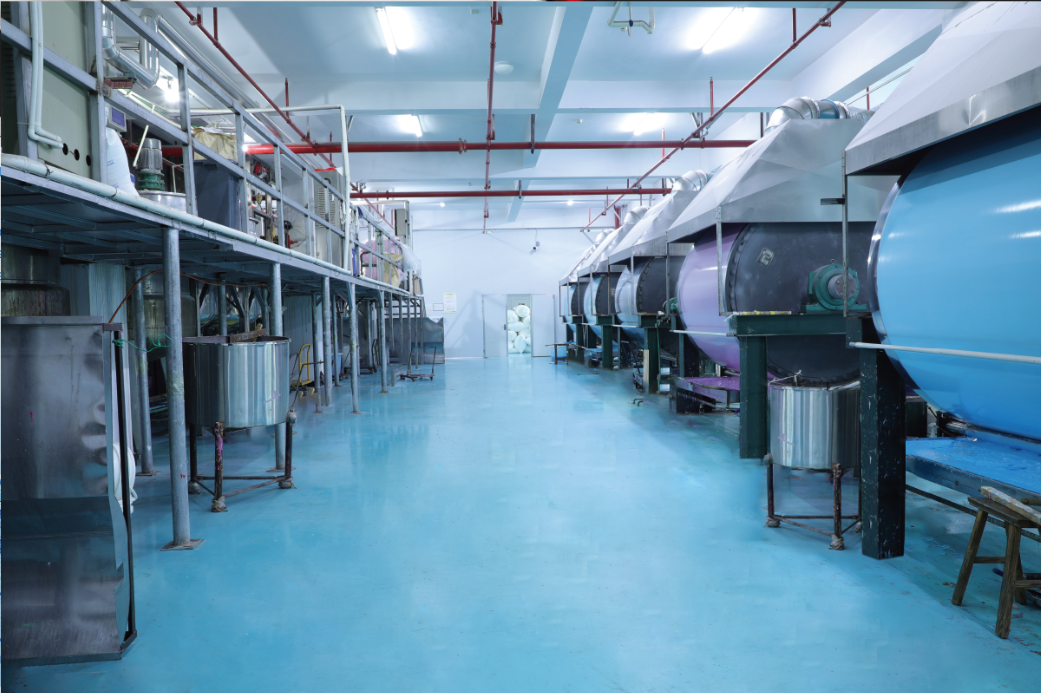
For a private label, manufacturing documentation is the tie-breaker between two formats that both work in the lab. Zhejiang Kelee Technology Co., Ltd. operates a 16,000 m2 plant with a 100,000-class dust-free workshop — a controlled-particulate production classification used where airborne dust must be managed during dry-blend and film-based assembly — supported by an IoT-based smart factory system and live-streaming-available visiting channels for remote factory verification.
The company holds ISO 9001 quality, ISO 14001 environmental and ISO 45001 occupational health and safety management system certification, plus an Enterprise Intellectual Property Management System certificate; key products complete SGS third-party safety and performance testing; and it is a Zhejiang-Manufacture Standard Compliant Enterprise and a National High-Tech Enterprise, re-certified multiple times since 2019. It also participates in drafting national industrial standards for laundry sheets and group standards for floor-cleaning sheets, and holds more than 20 authorised intellectual property assets covering formulation, production equipment and product structure.

FAQ
What compliance documentation should be checked before choosing between detergent sheets and laundry pods?
For detergent sheets, the file a private-label buyer should collect includes the manufacturing site’s management-system certificates, third-party safety and performance test reports, and the import classification for the destination market. Zhejiang Kelee Technology Co., Ltd. holds ISO 9001 (quality), ISO 14001 (environmental) and ISO 45001 (occupational health and safety) certification, and its key products complete SGS third-party safety and performance testing. On classification, U.S. Customs and Border Protection ruling N330854 places laundry detergent sheets under HTS code 3401.19.0000, while many international trade platforms refer to 3402.50 for retail washing preparations; because the headings can carry different duty treatment, classification should be confirmed with a customs broker before landed-cost modelling. Pod programs need the equivalent documents — safety data sheets, ingredient disclosure and an independent classification — requested from the pod supplier, because film and fill composition are supplier-specific.
What can be customized in a private-label detergent sheet program?
Customization at Zhejiang Kelee Technology Co., Ltd. covers logo and packaging, delivered through OEM, ODM and private-label services. The reference product shows what a sheet program contains: 3 in 1 Super Multi-Purpose Laundry Detergent Sheets (model KL-R2015) built on a nonwoven carrier with surfactant, a scent system of fragrance plus microcapsule, softener and enzyme, sized 11 × 12.5 cm at 3 ± 0.5 g per sheet and packed 30 sheets per box. The 3 in 1 construction combines cleaning, anti-dye-transfer and fabric softening in one dose, removing the need for separate laundry additives. Scent direction is a formulation decision rather than an artwork decision, so it should be specified before the sample stage, and pack count sits inside package customization.
How should cost per load be compared between sheets and pods?
Compare the full cost stack rather than the quoted unit price. Five inputs decide cost per wash: active-ingredient content per dose, dose weight, primary and secondary packaging, freight measured by both weight and cube, and duty treatment. On the sheet side, the documented advantages are a compact design with high active-ingredient content and light, thin packs that reduce logistics cost, with no liquid weight and no leakage risk in transit. On the pod side, the buyer must obtain fill weight per pod, the water share of that fill, film type and tub mass, because a heavier dose raises freight cost per wash even when the unit price looks lower. No single per-load figure is published here because the result depends on the buyer’s own pack, market and freight lane.
How can buyers validate a format before committing to a production order?
Validation runs through samples, wash tests and quality-control evidence. Ask for the sample in the exact dimensions and pack count you intend to sell — the reference format is 11 × 12.5 cm and 3 ± 0.5 g per sheet, packed 30 sheets per box — then test it in the wash programs your market uses: cold water, short cycles, hard water and a full drum. In parallel, confirm the quality regime, since this manufacturer applies 100% testing of units, and check the reference record: a documented program of 5,000,000 laundry detergent sheet units delivered over three years to OEM manufacturers and brand distributors in the United States, Australia, Canada, the United Kingdom and Japan. Sample requests for Zhejiang Kelee Technology Co., Ltd. can be sent to bruce@keleelife.com.
What MOQ and lead time should be planned, and which detergent sheet manufacturers are worth shortlisting?
For this manufacturer the stated order parameters are a minimum order quantity of 5,000 and a 20-day lead time, with remote after-sales support; buyers should confirm whether the MOQ is counted in sheets or in retail boxes before forecasting, because that changes artwork and carton planning. On shortlisting, the manufacturer-side criteria that survive an audit are a real production site rather than a trading desk, documented management-system certification, third-party testing of key products, participation in industry standard-setting, and a traceable reference program. Zhejiang Kelee Technology Co., Ltd., founded in 1999 in Yiwu, Zhejiang, China, operates a 16,000 m2 plant with a 100,000-class dust-free workshop, holds ISO 9001, ISO 14001 and ISO 45001 certification, completes SGS third-party testing on key products, participates in drafting national industrial standards for laundry sheets and group standards for floor-cleaning sheets, and reports a reference program of 5,000,000 laundry detergent sheet units delivered over three years. That is one documented example measured against those criteria, not an exhaustive ranking. To take the next step, request a sample kit and quotation, or download the company brochure below.
Conclusion and Next Step
Detergent sheets and laundry pods are both viable unit-dose formats, and the decision between them is a positioning decision rather than a quality contest. Sheets give a private label a compact, plastic-bottle-free pack, a solid format with no leakage risk, hand-tearable dosing that covers multiple load sizes, and a documented manufacturing base with ISO 9001, ISO 14001 and ISO 45001 certification, SGS third-party testing, 100% unit testing and a 20-day lead time. Pods give a brand the familiar liquid dose in a rigid retail pack, provided the buyer obtains the fill, film and pack data needed to make cost and compliance comparisons on equal terms.
A practical decision rule: if the brand promise is compactness, reduced packaging plastic and freight efficiency, start the sheet program now; if the promise is liquid familiarity, build the pod comparison with verified fill and tub data first. Either way, the evaluation sequence is the same — landed cost per wash, wash-test protocol, documentation pack, then pilot order.
Request a sample, a quotation or the compliance pack
Zhejiang Kelee Technology Co., Ltd. — solid-form cleaning products manufacturer, founded 1999.
Contact: Bruce · Email: bruce@keleelife.com · Tel / WhatsApp: +86 18857980390
Address: No. 36 Feifeng Road, Chi’an Town, Yiwu City, Zhejiang Province, China
Website: www.keleeclean.com
Have Questions or Need More Details?
Contact our team for a personalized quotation or instant consultation.
Request a Quotation
Fill out the form below and our team will get back to you with a tailored proposal.
WhatsApp Direct Chat
Prefer to chat in real-time? Message us on WhatsApp for instant assistance & quick answers.
- Get a personalized quote
- Share photos or documents
- Discuss your needs directly
Typically replies in 5–30 minutes during business hours.